Bensaad M-S, Dassamiour S, Hambaba L, Kahoul M-A, Benhoula M.
Evidence of anti-inflammatory and anti-ulcer properties of aerial parts of Centaurea tougourensis Boiss. and Reut. Tropical Journal of Pharmaceutical Research [Internet]. 2021;20 (8).
Publisher's VersionAbstract
Purpose: To determine the anti-inflammatory and anti-ulcer properties of the aerial parts of Centaurea tougourensis Boiss. & Reut.
Methods: The effects of n-butanol (n-BuOH) extract of the aerial part of Centaurea tougourensis on carrageenan-induced paw edema and ethanol-induced gastric mucosal damage were determined at 2 doses (200 and 400 mg/kg, po) in a mouse model. For each test, the animals were randomly divided into negative and positive control groups, as well as extract-treated groups. The mice were observed for any sign of inflammation for a period of 24h.
Results: Reduction of paw edema by C. tougourensis extract was highly significant (p < 0.001) at a dose of 400 mg/kg 24 h after carrageenan injection, with 55.26 % inhibition, followed very closely by 53.15 % inhibition at the dose of 200 mg/kg; indomethacin group showed an inhibition of 60 %. Histological examination supported the inhibition results. A significant reduction in inflammation by the extract at a dose of 400 mg/kg was also observed. No sign of ulcer was observed with C. tougourensis at the two doses (200 and 400 mg/kg). The total polyphenol content of the n-BuOH extract was 85.44 цg gallic acid equivalent/mg of extract. Tannins were the most abundant fraction (51.87 цg tannic acid equivalent/mg of extract), followed by flavonoids (25.55 цg quercetin equivalent/mg of extract).
Conclusion: The results indicate that C. tougourensis may have potential beneficial effects in the treatment of diseases associated with inflammation and pain, besides its protective effect on the gastrointestinal tract.
Bensaad M-S, Dassamiour S, Hambaba L, Kahoul M-A, Benhoula M.
Evidence of anti-inflammatory and anti-ulcer properties of aerial parts of Centaurea tougourensis Boiss. and Reut. Tropical Journal of Pharmaceutical Research [Internet]. 2021;20 (8).
Publisher's VersionAbstract
Purpose: To determine the anti-inflammatory and anti-ulcer properties of the aerial parts of Centaurea tougourensis Boiss. & Reut.
Methods: The effects of n-butanol (n-BuOH) extract of the aerial part of Centaurea tougourensis on carrageenan-induced paw edema and ethanol-induced gastric mucosal damage were determined at 2 doses (200 and 400 mg/kg, po) in a mouse model. For each test, the animals were randomly divided into negative and positive control groups, as well as extract-treated groups. The mice were observed for any sign of inflammation for a period of 24h.
Results: Reduction of paw edema by C. tougourensis extract was highly significant (p < 0.001) at a dose of 400 mg/kg 24 h after carrageenan injection, with 55.26 % inhibition, followed very closely by 53.15 % inhibition at the dose of 200 mg/kg; indomethacin group showed an inhibition of 60 %. Histological examination supported the inhibition results. A significant reduction in inflammation by the extract at a dose of 400 mg/kg was also observed. No sign of ulcer was observed with C. tougourensis at the two doses (200 and 400 mg/kg). The total polyphenol content of the n-BuOH extract was 85.44 цg gallic acid equivalent/mg of extract. Tannins were the most abundant fraction (51.87 цg tannic acid equivalent/mg of extract), followed by flavonoids (25.55 цg quercetin equivalent/mg of extract).
Conclusion: The results indicate that C. tougourensis may have potential beneficial effects in the treatment of diseases associated with inflammation and pain, besides its protective effect on the gastrointestinal tract.
Bensaad M-S, Dassamiour S, Hambaba L, Kahoul M-A, Benhoula M.
Evidence of anti-inflammatory and anti-ulcer properties of aerial parts of Centaurea tougourensis Boiss. and Reut. Tropical Journal of Pharmaceutical Research [Internet]. 2021;20 (8).
Publisher's VersionAbstract
Purpose: To determine the anti-inflammatory and anti-ulcer properties of the aerial parts of Centaurea tougourensis Boiss. & Reut.
Methods: The effects of n-butanol (n-BuOH) extract of the aerial part of Centaurea tougourensis on carrageenan-induced paw edema and ethanol-induced gastric mucosal damage were determined at 2 doses (200 and 400 mg/kg, po) in a mouse model. For each test, the animals were randomly divided into negative and positive control groups, as well as extract-treated groups. The mice were observed for any sign of inflammation for a period of 24h.
Results: Reduction of paw edema by C. tougourensis extract was highly significant (p < 0.001) at a dose of 400 mg/kg 24 h after carrageenan injection, with 55.26 % inhibition, followed very closely by 53.15 % inhibition at the dose of 200 mg/kg; indomethacin group showed an inhibition of 60 %. Histological examination supported the inhibition results. A significant reduction in inflammation by the extract at a dose of 400 mg/kg was also observed. No sign of ulcer was observed with C. tougourensis at the two doses (200 and 400 mg/kg). The total polyphenol content of the n-BuOH extract was 85.44 цg gallic acid equivalent/mg of extract. Tannins were the most abundant fraction (51.87 цg tannic acid equivalent/mg of extract), followed by flavonoids (25.55 цg quercetin equivalent/mg of extract).
Conclusion: The results indicate that C. tougourensis may have potential beneficial effects in the treatment of diseases associated with inflammation and pain, besides its protective effect on the gastrointestinal tract.
Messaoudi SA, Bouhoufani O, Hamchi I, Alahyane M.
Existence and blow up in a system of wave equations with nonstandard nonlinearities. Electronic Journal of Differential Equations [Internet]. 2021;91 :1–33.
Publisher's VersionAbstract
In this article, we consider a coupled system of two nonlinear hyperbolic equations, where the exponents in the damping and source terms are variables. First, we prove a theorem of existence and uniqueness of weak solution, by using the Faedo Galerkin approximations and the Banach fixed point theorem. Then, using the energy method, we show that certain solutions with positive initial energy blow up in finite time. We also give some numerical applications to illustrate our theoretical results.
Messaoudi SA, Bouhoufani O, Hamchi I, Alahyane M.
Existence and blow up in a system of wave equations with nonstandard nonlinearities. Electronic Journal of Differential Equations [Internet]. 2021;91 :1–33.
Publisher's VersionAbstract
In this article, we consider a coupled system of two nonlinear hyperbolic equations, where the exponents in the damping and source terms are variables. First, we prove a theorem of existence and uniqueness of weak solution, by using the Faedo Galerkin approximations and the Banach fixed point theorem. Then, using the energy method, we show that certain solutions with positive initial energy blow up in finite time. We also give some numerical applications to illustrate our theoretical results.
Messaoudi SA, Bouhoufani O, Hamchi I, Alahyane M.
Existence and blow up in a system of wave equations with nonstandard nonlinearities. Electronic Journal of Differential Equations [Internet]. 2021;91 :1–33.
Publisher's VersionAbstract
In this article, we consider a coupled system of two nonlinear hyperbolic equations, where the exponents in the damping and source terms are variables. First, we prove a theorem of existence and uniqueness of weak solution, by using the Faedo Galerkin approximations and the Banach fixed point theorem. Then, using the energy method, we show that certain solutions with positive initial energy blow up in finite time. We also give some numerical applications to illustrate our theoretical results.
Messaoudi SA, Bouhoufani O, Hamchi I, Alahyane M.
Existence and blow up in a system of wave equations with nonstandard nonlinearities. Electronic Journal of Differential Equations [Internet]. 2021;91 :1–33.
Publisher's VersionAbstract
In this article, we consider a coupled system of two nonlinear hyperbolic equations, where the exponents in the damping and source terms are variables. First, we prove a theorem of existence and uniqueness of weak solution, by using the Faedo Galerkin approximations and the Banach fixed point theorem. Then, using the energy method, we show that certain solutions with positive initial energy blow up in finite time. We also give some numerical applications to illustrate our theoretical results.
BOUGOFFA LAZHAR, Rach RC, MENNOUNI ABDELAZIZ.
On the existence, uniqueness, and new analytic approximate solution of the modified error function in two‐phase Stefan problems. Mathematical Methods in the Applied Sciences [Internet]. 2021;44 :10948-10956.
Publisher's VersionAbstract
This paper provides a new proof of the existence and uniqueness of the solution for a nonlinear boundary value problem
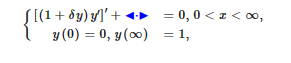
which describes the study of two-phase Stefan problems on the semi-infinite line [0, ∞). This result considerably extends the analysis of a recent work. A highly accurate analytic approximate solution of this problem is also provided via the Adomian decomposition method.
BOUGOFFA LAZHAR, Rach RC, MENNOUNI ABDELAZIZ.
On the existence, uniqueness, and new analytic approximate solution of the modified error function in two‐phase Stefan problems. Mathematical Methods in the Applied Sciences [Internet]. 2021;44 :10948-10956.
Publisher's VersionAbstract
This paper provides a new proof of the existence and uniqueness of the solution for a nonlinear boundary value problem
which describes the study of two-phase Stefan problems on the semi-infinite line [0, ∞). This result considerably extends the analysis of a recent work. A highly accurate analytic approximate solution of this problem is also provided via the Adomian decomposition method.
BOUGOFFA LAZHAR, Rach RC, MENNOUNI ABDELAZIZ.
On the existence, uniqueness, and new analytic approximate solution of the modified error function in two‐phase Stefan problems. Mathematical Methods in the Applied Sciences [Internet]. 2021;44 :10948-10956.
Publisher's VersionAbstract
This paper provides a new proof of the existence and uniqueness of the solution for a nonlinear boundary value problem
which describes the study of two-phase Stefan problems on the semi-infinite line [0, ∞). This result considerably extends the analysis of a recent work. A highly accurate analytic approximate solution of this problem is also provided via the Adomian decomposition method.
Baghdadi M, Dimia MS, Guenfoud M, Bouchair A.
An experimental and numerical analysis of concrete walls exposed to fire. Structural Engineering and Mechanics, An Int'l Journal [Internet]. 2021;77 (6) :819-830.
Publisher's VersionAbstract
To evaluate the performance of concrete load bearing walls in a structure under horizontal loads after being exposed to real fire, two steps were followed. In the first step, an experimental study was performed on the thermo-mechanical properties of concrete after heating to temperatures of 200-1000oC with the purpose of determining the residual mechanical properties after cooling. The temperature was increased in line with natural fire curve in an electric furnace. The peak temperature was maintained for a period of 1.5 hour and then allowed to cool gradually in air at room temperature. All specimens were made from calcareous aggregate to be used for determining the residual properties: compressive strength, static and dynamic elasticity modulus by means of UPV test, including the mass loss. The concrete residual compressive strength and elastic modulus values were compared with those calculated from Eurocode and other analytical models from other studies, and were found to be satisfactory. In the second step, experimental analysis results were then implemented into structural numerical analysis to predict the post-fire load-bearing capacity response of the walls under vertical and horizontal loads. The parameters considered in this analysis were the effective height, the thickness of the wall, various support conditions and the residual strength of concrete. The results indicate that fire damage does not significantly affect the lateral capacity and stiffness of reinforced walls for temperature fires up to 400oC.
Baghdadi M, Dimia MS, Guenfoud M, Bouchair A.
An experimental and numerical analysis of concrete walls exposed to fire. Structural Engineering and Mechanics, An Int'l Journal [Internet]. 2021;77 (6) :819-830.
Publisher's VersionAbstract
To evaluate the performance of concrete load bearing walls in a structure under horizontal loads after being exposed to real fire, two steps were followed. In the first step, an experimental study was performed on the thermo-mechanical properties of concrete after heating to temperatures of 200-1000oC with the purpose of determining the residual mechanical properties after cooling. The temperature was increased in line with natural fire curve in an electric furnace. The peak temperature was maintained for a period of 1.5 hour and then allowed to cool gradually in air at room temperature. All specimens were made from calcareous aggregate to be used for determining the residual properties: compressive strength, static and dynamic elasticity modulus by means of UPV test, including the mass loss. The concrete residual compressive strength and elastic modulus values were compared with those calculated from Eurocode and other analytical models from other studies, and were found to be satisfactory. In the second step, experimental analysis results were then implemented into structural numerical analysis to predict the post-fire load-bearing capacity response of the walls under vertical and horizontal loads. The parameters considered in this analysis were the effective height, the thickness of the wall, various support conditions and the residual strength of concrete. The results indicate that fire damage does not significantly affect the lateral capacity and stiffness of reinforced walls for temperature fires up to 400oC.
Baghdadi M, Dimia MS, Guenfoud M, Bouchair A.
An experimental and numerical analysis of concrete walls exposed to fire. Structural Engineering and Mechanics, An Int'l Journal [Internet]. 2021;77 (6) :819-830.
Publisher's VersionAbstract
To evaluate the performance of concrete load bearing walls in a structure under horizontal loads after being exposed to real fire, two steps were followed. In the first step, an experimental study was performed on the thermo-mechanical properties of concrete after heating to temperatures of 200-1000oC with the purpose of determining the residual mechanical properties after cooling. The temperature was increased in line with natural fire curve in an electric furnace. The peak temperature was maintained for a period of 1.5 hour and then allowed to cool gradually in air at room temperature. All specimens were made from calcareous aggregate to be used for determining the residual properties: compressive strength, static and dynamic elasticity modulus by means of UPV test, including the mass loss. The concrete residual compressive strength and elastic modulus values were compared with those calculated from Eurocode and other analytical models from other studies, and were found to be satisfactory. In the second step, experimental analysis results were then implemented into structural numerical analysis to predict the post-fire load-bearing capacity response of the walls under vertical and horizontal loads. The parameters considered in this analysis were the effective height, the thickness of the wall, various support conditions and the residual strength of concrete. The results indicate that fire damage does not significantly affect the lateral capacity and stiffness of reinforced walls for temperature fires up to 400oC.
Baghdadi M, Dimia MS, Guenfoud M, Bouchair A.
An experimental and numerical analysis of concrete walls exposed to fire. Structural Engineering and Mechanics, An Int'l Journal [Internet]. 2021;77 (6) :819-830.
Publisher's VersionAbstract
To evaluate the performance of concrete load bearing walls in a structure under horizontal loads after being exposed to real fire, two steps were followed. In the first step, an experimental study was performed on the thermo-mechanical properties of concrete after heating to temperatures of 200-1000oC with the purpose of determining the residual mechanical properties after cooling. The temperature was increased in line with natural fire curve in an electric furnace. The peak temperature was maintained for a period of 1.5 hour and then allowed to cool gradually in air at room temperature. All specimens were made from calcareous aggregate to be used for determining the residual properties: compressive strength, static and dynamic elasticity modulus by means of UPV test, including the mass loss. The concrete residual compressive strength and elastic modulus values were compared with those calculated from Eurocode and other analytical models from other studies, and were found to be satisfactory. In the second step, experimental analysis results were then implemented into structural numerical analysis to predict the post-fire load-bearing capacity response of the walls under vertical and horizontal loads. The parameters considered in this analysis were the effective height, the thickness of the wall, various support conditions and the residual strength of concrete. The results indicate that fire damage does not significantly affect the lateral capacity and stiffness of reinforced walls for temperature fires up to 400oC.
Boudjelal S, Fourar A, Massouh F.
Experimental and numerical simulation of free surface flow over an obstacle on a sloped channel. Modeling Earth Systems and Environment [Internet]. 2021;8 :1025–1033.
Publisher's VersionAbstract
In the present study, both experimental and numerical were conducted on a free surface flow over an obstacle. Numerical simulations were performed using the Renormalization Group (RNG-k-ɛ) based Reynolds-Averaged Navier–Stokes (RANS) turbulence model coupled with the Volume OF Fluid (VOF) method in FLUENT Software to investigate the effect of the channel slope on the flow pattern upstream, above and downstream the obstacle. Respectively, 5%, 7%, 8%, 10%, 20% and 50% channel slopes were considered. Numerical simulation has showed a good agreement compared against experimental results. Effect of the slope on the flow is observed particularly upstream of the obstacle where the flow takes the vertical direction after hitting the upstream wall. The more the slope becomes steeper, the higher the level of the water is. Recirculation zones in the case of a horizontal channel are elongated downstream the weir, whereas in the case of a sloped channel, they are localized just at the foot of the downstream wall.
Boudjelal S, Fourar A, Massouh F.
Experimental and numerical simulation of free surface flow over an obstacle on a sloped channel. Modeling Earth Systems and Environment [Internet]. 2021;8 :1025–1033.
Publisher's VersionAbstract
In the present study, both experimental and numerical were conducted on a free surface flow over an obstacle. Numerical simulations were performed using the Renormalization Group (RNG-k-ɛ) based Reynolds-Averaged Navier–Stokes (RANS) turbulence model coupled with the Volume OF Fluid (VOF) method in FLUENT Software to investigate the effect of the channel slope on the flow pattern upstream, above and downstream the obstacle. Respectively, 5%, 7%, 8%, 10%, 20% and 50% channel slopes were considered. Numerical simulation has showed a good agreement compared against experimental results. Effect of the slope on the flow is observed particularly upstream of the obstacle where the flow takes the vertical direction after hitting the upstream wall. The more the slope becomes steeper, the higher the level of the water is. Recirculation zones in the case of a horizontal channel are elongated downstream the weir, whereas in the case of a sloped channel, they are localized just at the foot of the downstream wall.
Boudjelal S, Fourar A, Massouh F.
Experimental and numerical simulation of free surface flow over an obstacle on a sloped channel. Modeling Earth Systems and Environment [Internet]. 2021;8 :1025–1033.
Publisher's VersionAbstract
In the present study, both experimental and numerical were conducted on a free surface flow over an obstacle. Numerical simulations were performed using the Renormalization Group (RNG-k-ɛ) based Reynolds-Averaged Navier–Stokes (RANS) turbulence model coupled with the Volume OF Fluid (VOF) method in FLUENT Software to investigate the effect of the channel slope on the flow pattern upstream, above and downstream the obstacle. Respectively, 5%, 7%, 8%, 10%, 20% and 50% channel slopes were considered. Numerical simulation has showed a good agreement compared against experimental results. Effect of the slope on the flow is observed particularly upstream of the obstacle where the flow takes the vertical direction after hitting the upstream wall. The more the slope becomes steeper, the higher the level of the water is. Recirculation zones in the case of a horizontal channel are elongated downstream the weir, whereas in the case of a sloped channel, they are localized just at the foot of the downstream wall.
Laouche M, Karech T, Rangeard D, Martinez J.
Experimental Study of the Effects of Installation of Sand Columns in Compressible Clay Using a Reduced Model. Geotechnical and Geological Engineering [Internet]. 2021;39 :2301-2312.
Publisher's VersionAbstract
The present study focuses on the investigation of the behaviour of a reduced model of a reinforced soil massif by a sand column tested in the laboratory. These tests involved the installation of sand columns in clay specimens (kaolin) by different methods. The specimens thus obtained are subjected to the same oedometric loading program. The first part of this work aims to study the effect of the intensity of the compaction stress of the sand columns on the surrounding soil and the effect on the behaviour of the soil-column massif. The sand columns were installed with the soil replacement method and with compacting of the columns (WR_WC). Three different compaction stresses were used to install the columns. In the second part, a sand column 20 mm in diameter was installed by two methods: one with replacement of the soil (WR) and without compaction and the other with displacement of the soil (WD). A comparison between the two methods has been established. By determining the equivalent characteristics for the soil-column massif, this study made it possible to characterize the effect of the installation method of the columns on the settlements, the void ratioe of kaolin, the equivalent void ratio eeq of the massif soil-column and on the compressibility parameters of the massif (equivalent compression index Cceq and swelling index Cseq), by comparing the results obtained with those of the unreinforced soils that constitute the reference case. The results obtained showed that the techniques used for the installation of columns have significant effects on the behaviour of reinforced massifs.
Laouche M, Karech T, Rangeard D, Martinez J.
Experimental Study of the Effects of Installation of Sand Columns in Compressible Clay Using a Reduced Model. Geotechnical and Geological Engineering [Internet]. 2021;39 :2301-2312.
Publisher's VersionAbstract
The present study focuses on the investigation of the behaviour of a reduced model of a reinforced soil massif by a sand column tested in the laboratory. These tests involved the installation of sand columns in clay specimens (kaolin) by different methods. The specimens thus obtained are subjected to the same oedometric loading program. The first part of this work aims to study the effect of the intensity of the compaction stress of the sand columns on the surrounding soil and the effect on the behaviour of the soil-column massif. The sand columns were installed with the soil replacement method and with compacting of the columns (WR_WC). Three different compaction stresses were used to install the columns. In the second part, a sand column 20 mm in diameter was installed by two methods: one with replacement of the soil (WR) and without compaction and the other with displacement of the soil (WD). A comparison between the two methods has been established. By determining the equivalent characteristics for the soil-column massif, this study made it possible to characterize the effect of the installation method of the columns on the settlements, the void ratioe of kaolin, the equivalent void ratio eeq of the massif soil-column and on the compressibility parameters of the massif (equivalent compression index Cceq and swelling index Cseq), by comparing the results obtained with those of the unreinforced soils that constitute the reference case. The results obtained showed that the techniques used for the installation of columns have significant effects on the behaviour of reinforced massifs.
Laouche M, Karech T, Rangeard D, Martinez J.
Experimental Study of the Effects of Installation of Sand Columns in Compressible Clay Using a Reduced Model. Geotechnical and Geological Engineering [Internet]. 2021;39 :2301-2312.
Publisher's VersionAbstract
The present study focuses on the investigation of the behaviour of a reduced model of a reinforced soil massif by a sand column tested in the laboratory. These tests involved the installation of sand columns in clay specimens (kaolin) by different methods. The specimens thus obtained are subjected to the same oedometric loading program. The first part of this work aims to study the effect of the intensity of the compaction stress of the sand columns on the surrounding soil and the effect on the behaviour of the soil-column massif. The sand columns were installed with the soil replacement method and with compacting of the columns (WR_WC). Three different compaction stresses were used to install the columns. In the second part, a sand column 20 mm in diameter was installed by two methods: one with replacement of the soil (WR) and without compaction and the other with displacement of the soil (WD). A comparison between the two methods has been established. By determining the equivalent characteristics for the soil-column massif, this study made it possible to characterize the effect of the installation method of the columns on the settlements, the void ratioe of kaolin, the equivalent void ratio eeq of the massif soil-column and on the compressibility parameters of the massif (equivalent compression index Cceq and swelling index Cseq), by comparing the results obtained with those of the unreinforced soils that constitute the reference case. The results obtained showed that the techniques used for the installation of columns have significant effects on the behaviour of reinforced massifs.